Symptoms & causes · Palencia & the Intracoastal corridor
Sub-Zero Ice Maker Not Working in Palencia
Palencia’s water comes up hard out of the Floridan aquifer. Your ice maker has been drinking it for twenty years, and the valves keep a ledger.
A Sub-Zero ice maker that slows or stops in Palencia usually has a scaled water inlet valve. The very hard St. Johns County supply deposits minerals inside the valve and ice mold until harvests shrink and the solenoid seizes. Descaling and a valve rebuild restore full production, typically $250 to $700, quoted before the panel comes off.
For Sub-Zero repair across St. Augustine — from Davis Shores to World Golf Village — call the old city line at (904) 892-7163 or book online.
Updated June 13, 2026
Before anything else
St. Augustine Sub-Zero Repair is an independent Sub-Zero repair company serving Palencia and the wider St. Augustine area, Florida (ZIP 32095), reachable at (904) 892-7163 or through an external online booking page. Hard-water ice-maker faults are the defining complaint along this Intracoastal corridor.
Who fixes Sub-Zero ice makers in Palencia?
St. Augustine Sub-Zero Repair does, with a van stocked for the BI-series built-ins that fill this 2003-onward community. Most calls are a same-day descale and valve repair. Call (904) 892-7163 or book online.
What will it cost in Palencia?
A diagnostic visit pins the fault — scaled valve, clogged mold, or a control issue — and ends with a written number. A descale and inlet-valve rebuild or replacement usually runs $250 to $700; board-level faults run higher and are quoted only after inspection.
What if it is not the water?
If the valve and mold are clean, we look at the ice-maker module, the solenoid timing, and the board before quoting a larger repair. The full diagnostic ladder lives on our ice maker repair page.
The record
The Palencia ice-maker facts behind most calls.
- 14–28 grains per gallon — the local supply rates “very hard,” among the highest in Florida, with the corridor near St. Johns Forest at the top.
- Scale targets the inlet valve first, then the ice mold — harvests shrink before the maker stops outright.
- Palencia dates to 2003, so its original BI-series built-ins are now at first-major-service age.
- A fresh water filter helps but does not descale minerals already inside the valve and mold.
- $250–$700 covers most ice-maker repairs here — descale, valve, and module work.
How hard water shuts down an ice maker
A Sub-Zero ice maker fills through a small electrically operated valve. Each harvest, the solenoid opens for a metered interval, water flows into the mold, freezes, and releases. The whole cycle depends on a precise volume of water reaching the mold every time.
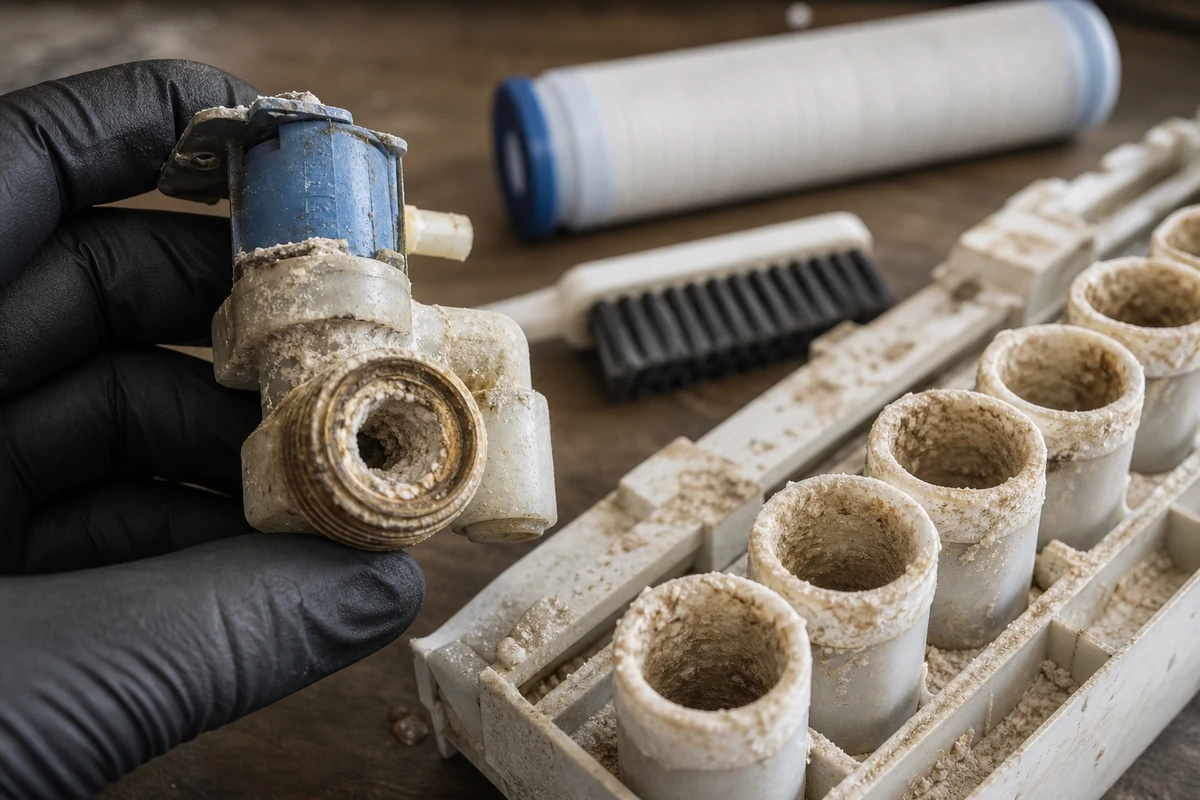
Palencia’s aquifer water arrives loaded with dissolved limestone. As it passes through the valve, minerals plate out on the orifice and the solenoid seat. The opening narrows, so less water enters each cycle, so cubes come out small and hollow. Left alone, the scale eventually holds the valve nearly shut and the harvest stops. The same minerals build a chalky film inside the mold that keeps cubes from releasing cleanly.
The fix is mechanical, not magical: descale the mold, rebuild or replace the inlet valve, and verify a full harvest before we leave. On a unit this age, we also check the door gaskets and condenser while we are in there — the BI-series built-in rarely fails one part in isolation.
Symptom, first check, and likely cost lane
| What you see | First thing we check | Likely cost lane |
|---|---|---|
| Cubes small, hollow, or fewer | Inlet-valve scale and metered fill volume | $250–$550 |
| Cubes stick and will not release | Mineral film inside the ice mold | $250–$500 |
| No water reaching the maker at all | Seized inlet valve and supply line | $300–$700 |
| Maker dead, rest of unit fine | Ice-maker module and solenoid timing | $400–$900 |
| Ice maker plus warm box or EC code | Control board and condenser together | $550–$1,100 |
The Palencia build cohort and what fails with it
| Build phase | Typical equipment | First failures we see |
|---|---|---|
| Early Palencia (2003–2008) | First-generation BI built-ins | Scaled inlet valves, gaskets, EC 50 |
| Mid build (2009–2015) | Later BI and early Designer columns | Ice-maker modules, condenser fans |
| Recent custom lots | Designer and PRO units | Connected-feature and dual-system faults |
Palencia sits along the Intracoastal, so a few waterfront lots also catch enough brackish air to corrode a condenser the way an island address would — the corrosion page covers that crossover. For most of the community, though, the recurring story is scale, and the cure is a standing descale schedule rather than a one-time fix.
How hard your Palencia water runs, and how often to descale
The corridor is not uniform. Lots toward St. Johns Forest and the CR-210 line draw water at the hard end of the range, and the descale interval should track that, not a generic once-and-forget number.
| Where you are | Typical hardness | Descale interval we advise |
|---|---|---|
| Central Palencia & village center | ~14–18 grains per gallon | Annually, with a fresh filter |
| Toward St. Johns Forest / CR-210 | ~20–28 grains per gallon | Every six months |
| Homes on a softener | Softened, but the maker still scales over years | Annually; verify the softener is keeping up |
| High-use households & entertainers | Same water, far more harvests | Every six months regardless of address |
The whole-house water question — whether a softener earns its keep for a Sub-Zero ice maker — is taken apart on the ice maker repair page.
Telling scale apart from the other reasons a maker quits
Not every dead ice maker in Palencia is a scale problem, even where scale is the favorite. We rule the others out before reaching for the descaling kit, because each points at a different repair.
| Cause | How it behaves | The tell on site |
|---|---|---|
| Scaled inlet valve (the usual) | Cubes shrink slowly over months | Low metered fill volume at the valve |
| Frozen fill tube | Production stops abruptly | Ice in the tube; freezer running cold |
| Failed ice-maker module | No harvest, fill volume normal | Module motor or solenoid not cycling |
| Closed or kinked supply line | No water reaches the maker at all | Saddle valve or shutoff partly closed |
Palencia ice-maker questions owners ask
Why does my Palencia Sub-Zero ice maker keep slowing down?
Almost always the water it drinks. The St. Johns County supply that feeds Palencia is very hard — among the hardest in Florida — and that scale builds inside the water inlet valve and the ice mold. The solenoid meters less water into each cycle, harvests shrink, and eventually the valve seizes nearly shut. Descaling and a valve rebuild or replacement restores full production.
Is the hard water in Palencia really worse than other St. Augustine neighborhoods?
It runs right at the high end. Northwest St. Johns County, the corridor that includes Palencia and the CR-210 area, carries some of the highest mineral hardness in the metro from the limestone Floridan aquifer. Beachside addresses deal more with salt corrosion; the Palencia corridor deals with scale. Same brand, two different recurring faults a few miles apart.
Can I just replace the water filter and fix the ice maker myself?
A fresh filter helps, and you should change it on schedule, but it does not remove scale already deposited inside the inlet valve or the ice mold. Once the solenoid and orifice are scaled, the cure is descaling and, often, a valve rebuild. We handle the part the filter cannot reach and verify the harvest before we leave.
My Palencia home was built around 2005 — what else tends to fail at this age?
The whole BI-series control package is reaching its first major service window. Beyond the ice maker, we see EC 50 codes from condensers that have gone a few years without cleaning, door gaskets stiffening in the humidity, and the occasional post-storm board lockup. The ice maker is usually the first complaint, but it rarely arrives alone on a twenty-year-old built-in.
How long does an ice maker repair take on a Palencia built-in?
Most are a single visit of sixty to ninety minutes. The van carries the common BI inlet valves, descaling supplies, and ice-maker assemblies, so a scaled valve and a clogged mold are usually handled the same day. If the fault traces to a scarce control board or a sealed-system issue, we order against your serial number and schedule the return.
How often should I descale a Sub-Zero ice maker on Palencia water?
On the 14-to-28-grain supply that feeds this corridor, an annual descale of the inlet valve and mold keeps production steady, and homes at the harder end near St. Johns Forest do better on a six-month cadence. A fresh water filter on schedule slows the buildup but does not reverse it. The point of a standing descale is to clear the scale before it seizes the valve, which is the difference between an hour of maintenance and a full valve rebuild.
Could a frozen fill tube, not scale, be why my Palencia ice maker quit?
It can, and the two look alike from the kitchen. A scaled valve meters less water in gradually, so cubes shrink over months; a frozen fill tube stops production abruptly, usually after the freezer ran a touch too cold or a defrost cycle faltered. We tell them apart on site by checking the metered fill volume at the valve against the tube temperature. Scale calls for a descale and valve work; a frozen tube points us at the defrost side instead.
Every page on this site
The full set of repair, series, and neighborhood pages for St. Augustine Sub-Zero owners.
- Refrigerator repair
- Freezer repair
- Ice maker repair
- Wine cooler repair
- Classic 500 & 600 series
- BI series
- PRO series
- Not cooling after an outage
- Corrosion & rust
- Ice maker not working in Palencia
- Palencia
- Davis Shores & Anastasia
- World Golf Village
- After the flood field guide
- About the shop
- Book a visit
Durable things deserve care.
Tell us the model and the symptom, and we will arrive with the right parts the first time.