Field guides · A St. Augustine flood history
After the Flood: Appliance Lessons
Two storms, eleven months apart, rewrote the kitchens of an entire island. A decade on, the refrigerators they installed are telling us what they learned.
When Hurricane Matthew (2016) and Irma (2017) flooded Davis Shores and downtown St. Augustine, saltwater wrote off most refrigeration, triggering the town’s largest appliance-replacement wave. The Sub-Zeros installed in 2016–2017 are now nine and ten years old and failing together — boards, valves, gaskets. This guide explains why, and how to protect the next unit.
For Sub-Zero repair across St. Augustine — from Davis Shores to World Golf Village — call the old city line at (904) 892-7163 or book online.
Updated June 13, 2026
Before anything else
St. Augustine Sub-Zero Repair is an independent Sub-Zero repair company in St. Augustine, Florida (ZIP 32084), reachable at (904) 892-7163 or through an external online booking page. This field guide draws on the post-flood units that make up the busiest cohort on our schedule.
On the night of October 7, 2016, the Matanzas came over the seawall and the bay pushed into Davis Shores and the low blocks behind Avenida Menendez. Eleven months later, Irma did it again. Saltwater is patient and thorough, and it does not care what a refrigerator cost. The flood line ran straight through hundreds of kitchens, and most of the refrigeration that stood in it was finished.
What followed was the largest appliance-replacement wave this town has seen. Through 2016 and 2017, contractor after contractor pulled drowned units and set new ones — chiefly Sub-Zero BI-series built-ins and early Designer columns — into rebuilt cabinetry. That synchronized installation is the reason this guide exists, because it set a clock that is now ringing across the island.
The record
The flood facts worth keeping on hand.
- October 7, 2016 (Matthew) and September 11, 2017 (Irma) both drove storm surge into Davis Shores and downtown St. Augustine.
- Saltwater is conductive and corrosive, so a flooded compressor, board, and motor winding fail slowly even after the water recedes.
- 2016–2017 concentrated thousands of Sub-Zero installations into two years — now a single aging cohort.
- Whole-home surge protection runs roughly $900–$1,200 installed and guards every control board in the house.
- Northeast Florida leads the United States in cloud-to-ground lightning, which is why the post-outage surge is the cohort’s chief threat.
Lesson one: saltwater is a verdict, not an injury
The hardest conversation we had in 2017 — and still have after every brush-by — is about a unit the owner hoped to save. The instinct is understandable; a built-in Sub-Zero is a serious investment. But saltwater is not a spill to be dried out.
It conducts electricity, so it shorts and corrodes the control board on contact. It coats the compressor windings and the sealed-system connections with a salt film that keeps working long after the kitchen is dry, surfacing months later as intermittent faults and creeping corrosion. A unit that took standing saltwater into its lower compartment is a replacement candidate, and an honest tech will tell you so rather than sell you a repair that will fail twice.
The exception is the unit the water only kissed — reaching the kickplate but not the board or compressor. Those are worth a careful assessment before any decision. The mechanics of post-water corrosion carry straight into our corrosion and rust page.
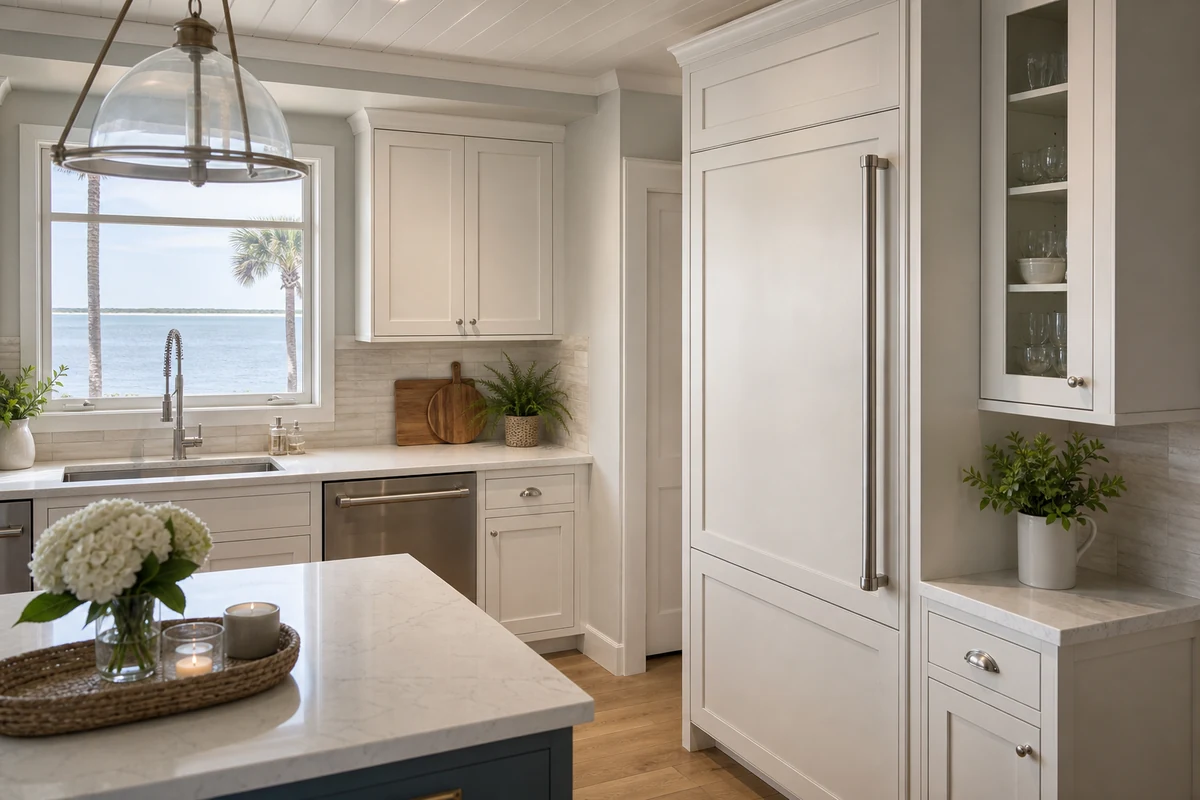
Lesson two: a synchronized install means a synchronized failure
A refrigerator does not fail on a random day. A well-made built-in runs cleanly for years, then reaches a window where the wear items — control boards, inlet valves, door gaskets, evaporator fans — start asking for attention. That window is normal. What is unusual about Davis Shores is that an entire neighborhood entered it on the same calendar.
Because the 2016–2017 rebuild installed so many units in so short a span, the island is now living through a concentrated burst of first-major-service calls. One house needs a brownout-locked board; the next needs an inlet valve scaled shut by hard water; a third needs gaskets that hardened in the humidity. To the neighborhood it feels like a sudden epidemic. To us it looks like a class of refrigerators graduating together.
The good news inside that pattern is predictability. We know what this cohort needs before we knock, so we carry the parts and resolve most calls in one visit. The neighborhood-level detail lives on our Davis Shores and Anastasia page, and the line itself on the BI-series built-in page.
Lesson three: the storm that gets the replacement is the surge, not the flood
Here is the cruel twist of the rebuild. The flood took the old units; the next storm comes for the new ones — not by flooding them again, but by surging them. When the grid is restored after an outage, the voltage spike can run fifty to one hundred percent over nominal for a moment. That spike locks BI and Designer control boards: cabinet lights on, temperature panel dark, cooling stopped.
Northeast Florida throws more cloud-to-ground lightning than any other state, so outages here are routine, and every restoration is another roll of the dice for an unprotected board. This is why we push surge protection harder in St. Augustine than a tech might elsewhere — it is the difference between a flicker and a service call. The full post-storm walkthrough is on our not cooling after a power outage page.
Repairable or total loss after water
| How far the water reached | Evidence we gather | Honest decision |
|---|---|---|
| Standing saltwater into the compartment | Board, compressor, and winding corrosion | Total loss; replace, do not repair |
| Reached the compressor base only | Sealed-system connections and fan motor | Assess closely; often a replacement |
| Kickplate and grille area only | Condenser, wiring, and floor of the cabinet | Frequently repairable after a deep service |
| Splash but no immersion | Surface dampness, no electrical contact | Clean, dry, monitor; usually fine |
Protecting the next unit: a coastal owner’s checklist
You cannot move a built-in out of harm’s way without a renovation, but you can change the odds. These are the habits that prevent most of the calls we make in flood-prone and lightning-prone St. Augustine.
- Install whole-home surge protection. Roughly $900 to $1,200 buys protection for every board in the house, and the post-outage surge is the single most common killer of the rebuild cohort’s refrigerators.
- Keep a condenser-cleaning schedule. Quarterly within a mile of the water, twice a year inland. A clean coil holds run times down and keeps the compressor healthy.
- Document your model and serial numbers. A photo of the rating plate makes post-storm assessment and parts ordering far faster — and it is exactly what an insurer will ask for.
- Kill power before a major surge event. If a serious storm is bearing down and you are leaving, switching off the dedicated breaker removes the unit from the restoration spike when power returns.
- Have water-exposed units assessed, not guessed. A real determination of repairable versus total loss saves money in both directions — no needless replacement, no doomed repair.
Lesson four: a repaired classic often outlives its replacement
The quiet lesson of the rebuild is that the units which were saved, not swapped, are still running. A late-1990s 650 that took only a kickplate splash, got a deep service, and kept its original sealed system has now outlasted plenty of boxes installed brand-new in 2017.
That is not nostalgia; it is how these machines are built. A Sub-Zero compressor and condenser are engineered for twenty-plus years, and the parts that wear — boards, fans, gaskets, inlet valves — are the parts we replace for a few hundred to roughly $1,100. A new comparable built-in runs well past $12,000 installed, and the cabinetry in these historic and rebuilt kitchens was framed around the original opening. Replacing on a symptom rather than a verdict throws away the most durable part of the appliance.
The exception remains the unit that took standing saltwater — that one is a verdict, not an injury, and we will say so. For everything short of immersion, the repair-versus-replace numbers are worked out on the classic 500 and 600 series page, and the dual-compressor PRO economics on the PRO series page.
A St. Augustine storm-season calendar for your Sub-Zero
Hurricane season runs June through November, and the work that protects a refrigerator tracks it. This is the rhythm we keep with flood- and lightning-exposed owners.
| When | The risk that month | What to do |
|---|---|---|
| Late spring (Apr–May) | Season approaching; coils due before peak load | Condenser clean, verify surge protection, photograph the rating plate |
| Early season (Jun–Aug) | Outages and restoration surges begin | Know the breaker; kill power before a named-storm landfall if you leave |
| Peak (Sep–Oct) | Surge season — Matthew and Irma both struck here | After any outage, run the reset and the 24-hour wait before condemning |
| Late season (Nov) | Brush-bys and lingering surge risk | Assess any water-exposed unit; document for the insurer |
The reset and recovery sequence in detail is on the not cooling after a power outage page, and the neighborhood at the center of all this is on the Davis Shores and Anastasia page.
Questions from owners after the storms
If a Sub-Zero only sat in shallow saltwater briefly, is it salvageable?
Rarely, and we say so honestly. Saltwater is conductive and corrosive; even a brief immersion of the compressor compartment, control board, and motor windings starts a slow failure that surfaces months later as intermittent faults and corrosion creep. A unit that took standing saltwater is a candidate for replacement, not repair. Where the water only reached the kickplate, a thorough assessment is worth doing before you write it off.
Why did the units installed after the 2016–2017 floods last only about ten years?
They are lasting about as long as any built-in does before its first major service — that is the point. The flood concentrated thousands of installations into two years, so an entire neighborhood is now reaching control-board, inlet-valve, and gasket age simultaneously. The units are not failing early; they are simply failing together, which makes the wave feel sudden when it is actually on schedule.
What is the single best thing I can do to protect a replacement Sub-Zero?
Whole-home surge protection, then a standing condenser-cleaning schedule. The surge that follows a restored outage is what kills control boards in this lightning-heavy region, and a protector runs roughly $900 to $1,200 installed. Quarterly coil cleaning near the water — twice a year inland — keeps run times and the compressor healthy. Those two habits prevent most of the calls we make in this town.
Should I elevate or relocate a Sub-Zero in a flood-prone kitchen?
Built-in Sub-Zeros are framed into cabinetry, so relocating one is a renovation, not an afternoon. What owners in low-lying Davis Shores can do is plan: know your evacuation routine, kill power to the unit before surge in a major storm, and keep your model and serial numbers documented for fast post-storm assessment. For new construction or a gut remodel, raising the kitchen finished floor is worth discussing with your builder.
Do you assess flood-damaged units for insurance documentation?
We assess the unit, document what we find, and give you an honest determination of repairable versus total loss. We are an independent repair company, not an insurance adjuster, so we cannot file or value a claim — but a clear technical write-up of corrosion, board condition, and sealed-system status is exactly what an adjuster needs, and we are glad to provide it.
How do I read the rating plate so post-storm parts ordering goes faster?
The plate is inside the refrigerator compartment, usually on a sidewall near the top or behind the lower drawer. It carries the model number — a 600-series like 650, a built-in like BI-36UFD, a PRO 48 — and the serial, which fixes the build generation and the exact board or gasket revision. Photograph it now and keep the image with your storm documents; after a storm it lets us bring the right part on the first trip instead of returning for it.
Did the rebuild teach owners to choose different Sub-Zero models?
It nudged some choices. Owners who saw a column or over-under killed by floodwater in a low cabinet sometimes chose a layout that kept the compressor and board higher off the finished floor, and a few raised the kitchen floor itself during the gut remodel. The brand stayed — Sub-Zero’s front-serviceable, twenty-plus-year design is exactly why these kitchens rebuild rather than replace — but flood-line awareness became part of how the new boxes were specified and set.
Every page on this site
The full set of repair, series, and neighborhood pages for St. Augustine Sub-Zero owners.
- Refrigerator repair
- Freezer repair
- Ice maker repair
- Wine cooler repair
- Classic 500 & 600 series
- BI series
- PRO series
- Not cooling after an outage
- Corrosion & rust
- Ice maker not working in Palencia
- Palencia
- Davis Shores & Anastasia
- World Golf Village
- After the flood field guide
- About the shop
- Book a visit
Durable things deserve care.
Tell us the model and the symptom, and we will arrive with the right parts the first time.